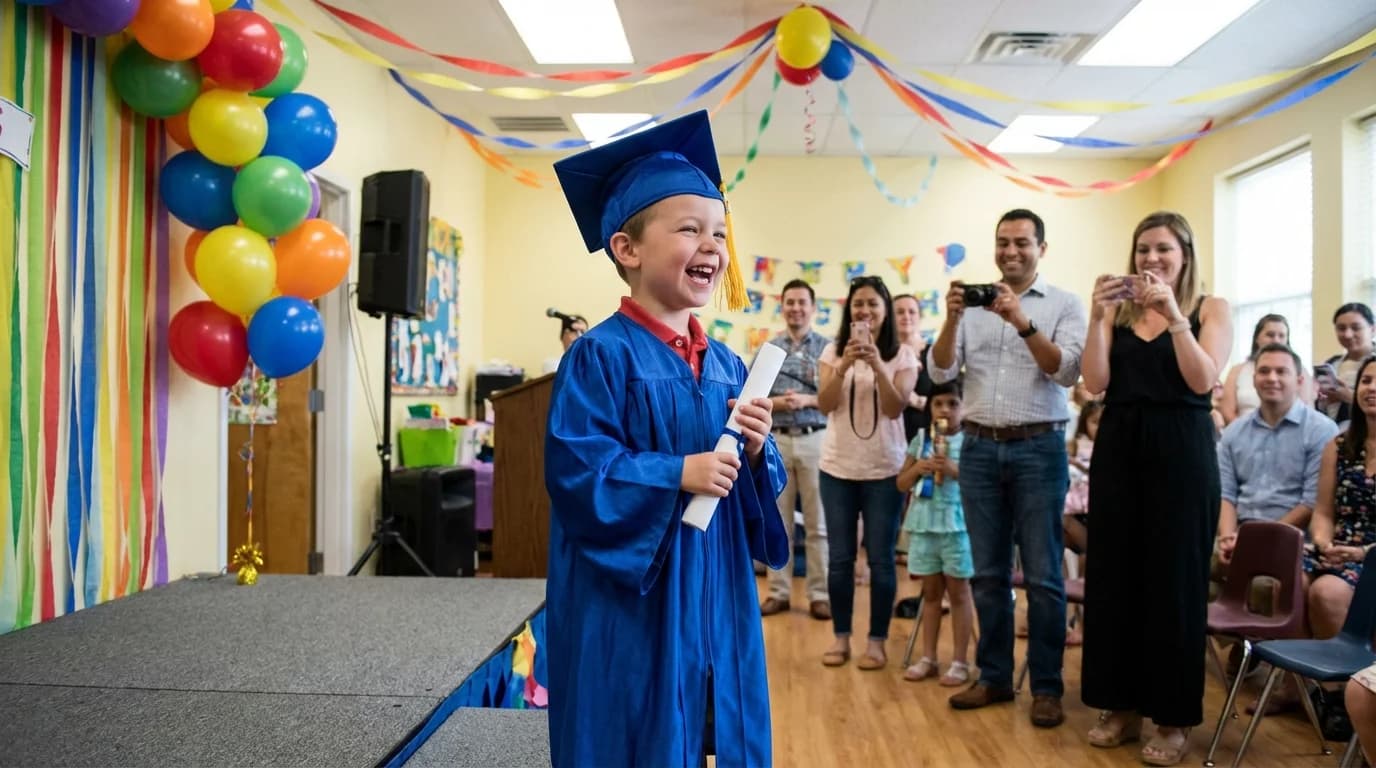
For many Brooklyn families, the daycare years feel like they will last forever, and then suddenly they are over. Your child who once needed help holding a sippy cup is now ready for kindergarten, and you are left wondering whether they are truly prepared, how to navigate the NYC enrollment process, and what you can do over the summer to set them up for success. If you are a parent in East Flatbush or the surrounding neighborhoods, this guide will help you understand what kindergarten readiness actually means, how a quality daycare experience gives your child an enduring advantage, and how to make this transition a positive one for your whole family.
What Kindergarten Readiness Really Means
There is a persistent myth among parents that kindergarten readiness means a child can read, write their name, and count to one hundred. This misunderstanding creates unnecessary anxiety and leads some families to push academic drilling on four-year-olds at the expense of the play-based learning that actually builds readiness.
The National Association for the Education of Young Children (NAEYC) defines developmentally appropriate practice as methods that promote each child's optimal development and learning through a strengths-based, play-based approach. Their position is clear: kindergarten readiness is not about academics. It is about the whole child.
Here is what kindergarten teachers in Brooklyn and across New York City actually look for when they meet your child in September:
Social and Emotional Skills
Can your child separate from you without prolonged distress? Can they follow simple two-step directions? Do they take turns, share materials, and express their needs with words rather than hitting or crying? These social-emotional competencies are, by a wide margin, the strongest predictors of kindergarten success. Research consistently shows that children who enter kindergarten with strong social-emotional skills outperform their peers academically by third grade, regardless of the age at which they learned to read.
Self-Regulation and Independence
Kindergarten requires children to manage themselves in ways that daycare and preschool gently prepare them for: sitting for a short group activity, transitioning between tasks, managing their belongings, using the bathroom independently, and handling small frustrations without falling apart. The American Academy of Pediatrics notes that these self-regulation skills develop through practice in structured environments, which is precisely what a quality daycare provides every day.
Language and Communication
Can your child express their thoughts in sentences? Do they understand and respond to questions? Can they participate in a conversation, taking turns speaking and listening? Strong oral language is the foundation upon which literacy is built. A child who enters kindergarten with a rich vocabulary and the ability to narrate a simple story is better prepared for reading instruction than a child who can decode letters but lacks comprehension skills.
Fine and Gross Motor Skills
Holding a pencil, cutting with scissors, running, climbing, and catching a ball are all part of kindergarten readiness. These skills develop through the hands-on activities that characterize a centers-based daycare environment: building with blocks, painting at an easel, molding clay, and active outdoor play.
Curiosity and a Love of Learning
Perhaps the most important quality a child can bring to kindergarten is genuine curiosity. Does your child ask questions? Do they explore materials with interest? Are they willing to try new things, even when those things are challenging? This disposition toward learning, far more than any specific academic skill, predicts long-term educational success.
The NYC Kindergarten Enrollment Process
Navigating the New York City public school enrollment process can feel overwhelming, but understanding the timeline and key steps will help you approach it with confidence.
According to the NYC Department of Education, children born in 2021 are eligible for kindergarten beginning in September 2026. Every five-year-old New York City resident is guaranteed a seat in a public school kindergarten program.
Key Dates and Steps
Fall (the year before kindergarten): Begin researching schools in your zone. Use MySchools.nyc to explore programs, compare schools, and identify your zoned school. Attend open houses when available.
December through January: The kindergarten application opens in early December and typically closes in late January. Submit your application through MySchools. You can list up to twelve schools in order of preference, though if you have a zoned school, you are guaranteed a seat there.
March: Kindergarten offers are released, typically at the end of March. You will receive an offer to one school.
Important note: If your child currently attends pre-K at a DOE public elementary school, they will have an admissions priority to attend kindergarten at that school, but you still need to submit an application.
For families considering the Gifted and Talented program, the application process has its own timeline and requirements. Research this early if it interests you.
The Quality Daycare Advantage
If your child has attended a quality daycare program, they arrive at kindergarten with significant advantages that research has consistently documented.
Children who experience a structured, research-backed curriculum like the Creative Curriculum during their preschool years develop stronger pre-academic skills, more advanced social competencies, and greater self-regulation abilities than children who enter kindergarten without structured early childhood education. This is not because they have been drilled on flashcards, but because they have spent years in an environment intentionally designed to build the foundational skills that all later learning depends on.
The NAEYC's research on developmentally appropriate practice in kindergarten confirms that play-based learning in the preschool years leads to stronger academic outcomes than early academic instruction. Children who play with blocks develop spatial reasoning. Children who engage in dramatic play build narrative skills. Children who negotiate with peers during group activities develop the executive function skills that drive academic performance. To learn more about how this approach works in practice, read our article on what the Creative Curriculum is and why it matters.
How GOLD Reports Support the Kindergarten Transition
If your child's daycare uses Teaching Strategies GOLD for developmental assessment, you have a powerful tool to support the kindergarten transition. GOLD tracks your child's progress across multiple domains of development: social-emotional, physical, language, cognitive, literacy, and mathematics.
Request a comprehensive GOLD report before your child leaves daycare. This report provides:
- A developmental snapshot. Where your child stands relative to age-appropriate expectations across all domains, not just academics.
- Specific strengths. Areas where your child excels, which can help a kindergarten teacher build on existing competencies.
- Growth areas. Skills that are still developing, allowing the kindergarten teacher to provide targeted support from day one rather than spending weeks assessing what your child can and cannot do.
- Evidence of progress. GOLD reports track growth over time, so the kindergarten teacher can see not just where your child is, but how quickly they are progressing.
Share this report with your child's kindergarten teacher during the first parent-teacher conference or, ideally, before school begins. Many kindergarten teachers appreciate receiving this information because it allows them to differentiate instruction from the very first week.
The Emotional Transition
The shift from daycare to kindergarten is not just logistical. It is deeply emotional for both children and parents.
Your child is leaving teachers who have known them intimately, friends who have been a daily presence, and routines that have structured their world for years. Even children who are excited about being "big kids" may experience grief, anxiety, or ambivalence about this change.
The Zero to Three foundation recommends acknowledging these feelings openly. Avoid dismissing sadness with phrases like "you are a big kid now" or "there is nothing to be worried about." Instead, validate: "It makes sense that you feel sad about leaving your teachers. You loved them, and they loved you. And you are going to make wonderful new connections at your new school."
For parents, this transition can be surprisingly emotional as well. The daycare years represent your child's earliest steps into the world beyond your family, and watching them move on marks the passage of time in a way that few other milestones do. Give yourself permission to feel whatever comes up.
Summer Preparation: What to Do (and What Not to Do)
The summer before kindergarten is a natural time to help your child prepare, but resist the urge to turn it into a boot camp.
Do
- Practice independence skills. Getting dressed, packing a backpack, opening a lunch container, using the bathroom and washing hands without help. These practical skills reduce anxiety more than any academic preparation.
- Read together daily. Not to teach reading, but to build vocabulary, comprehension, and a love of stories. Talk about what you read. Ask questions. Let your child predict what will happen next.
- Visit the school. If your child's new school offers a summer visit or orientation, attend. Walk around the building, find the bathroom, meet the teacher if possible. Familiarity reduces anxiety.
- Play with peers. Arrange playdates, visit playgrounds, and give your child opportunities to practice the social skills they will need: joining a group, compromising, handling conflict, and making new friends.
- Establish the school routine early. Two weeks before school begins, start shifting bedtime and wake-up time to match the kindergarten schedule. Practice the morning routine so it feels familiar on the first day.
Do Not
- Drill academics. Worksheets, flashcards, and forced writing practice create negative associations with learning. If your child has attended a quality daycare with an intentional curriculum, they already have the foundational skills they need.
- Express anxiety. Children absorb parental emotions. If you are worried about kindergarten readiness, discuss your concerns with the teacher or your pediatrician rather than expressing them in front of your child.
- Compare your child to others. Every child develops on their own timeline. A child who enters kindergarten unable to write their name but brimming with curiosity and social confidence is better prepared than a child who can write the alphabet but falls apart at the first challenge.
What If You Have Concerns About Readiness?
If you genuinely believe your child is not ready for kindergarten, start by talking with their current daycare teachers. They observe your child in a structured group setting every day and can offer a more objective assessment than any parent can provide from home.
Review GOLD assessment data or any other developmental reports your daycare provides. If the data shows your child is meeting age-appropriate expectations, trust the data even if your parental instinct says otherwise. Parents often underestimate their children's capabilities, particularly their first child.
If there are legitimate developmental concerns, talk with your pediatrician and consider requesting an evaluation through the NYC DOE's Committee on Preschool Special Education. Early identification of learning differences allows kindergarten teachers to provide appropriate support from the start. Understanding your child's social-emotional development in the context of their overall growth can help you and their teachers develop the right support strategy.
The Gift of a Strong Start
The transition from daycare to kindergarten is one of the most significant passages in your child's early life. It marks the beginning of their formal education journey, a journey that will shape their relationship with learning for years to come.
If your child has spent their daycare years in an environment that valued play, nurtured curiosity, built social skills, and respected their individual developmental timeline, they are ready. Not because they can pass a test, but because they have developed the foundational dispositions, the confidence, the resilience, the love of learning, that will carry them through kindergarten and far beyond.
Give your child the strongest possible foundation for kindergarten and beyond. At Einstein Daycare in East Flatbush, Brooklyn, we use the Creative Curriculum and Teaching Strategies GOLD assessments to ensure every child develops the social, emotional, cognitive, and physical skills that kindergarten teachers value most. Our enrichment programs in yoga and music go beyond the basics to nurture the whole child.
Schedule a tour of our 900 Lenox Rd facility to see how we prepare Brooklyn's children for lifelong learning, or call us at (718) 618-7330.