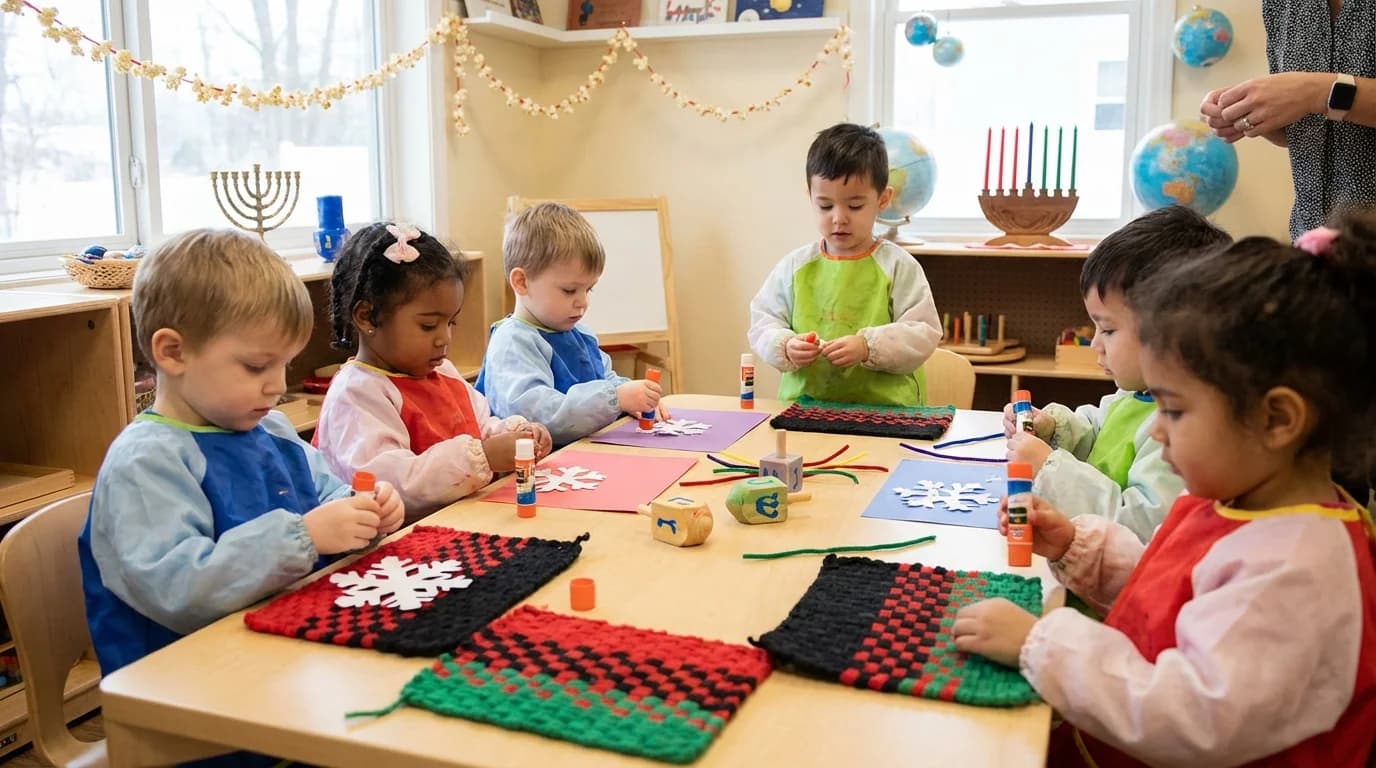
Brooklyn is home to families from virtually every corner of the world. Walk through Crown Heights, East Flatbush, or Flatbush on any given day and you will hear Haitian Creole, Jamaican Patois, Yiddish, Spanish, Yoruba, and a dozen other languages. You will pass Caribbean bakeries, kosher delis, West African markets, and Latino bodegas on the same block. This extraordinary cultural richness is one of the great gifts of raising a child in Brooklyn, and it should be reflected in every aspect of your child's daycare experience, including how holidays and cultural traditions are celebrated.
But navigating cultural celebrations in an early childhood setting is more nuanced than hanging decorations for every holiday on the calendar. Quality daycare programs approach cultural diversity with intentionality, research-based strategies, and deep respect for the communities they serve. Here is what that looks like in practice and why it matters so much for your child's development.
Why Cultural Representation Matters in Early Childhood
Children begin noticing differences in skin color, language, and cultural practices as early as six months of age. By age two, they are actively categorizing people based on observable characteristics. By three and four, they are forming attitudes about their own identity and the identities of others that can persist into adulthood.
This is not speculation. It is well-documented developmental science. The NAEYC's position statement on advancing equity in early childhood education makes clear that early childhood programs have both an opportunity and a responsibility to shape how children understand identity, difference, and belonging. Programs that ignore cultural diversity or treat it superficially, the "tourist approach" of sampling exotic foods and coloring flags once a year, miss this critical developmental window.
Research consistently shows that children who see their own culture reflected in their learning environment develop stronger self-concept and greater confidence. Equally important, children who are exposed to diverse cultures and perspectives in authentic, respectful ways develop greater empathy, cognitive flexibility, and comfort with difference. These are not merely nice qualities. They are essential skills for navigating the world your child will grow up in.
Moving Beyond the Tourist Approach
Many well-intentioned daycare programs fall into what early childhood educators call the "tourist approach" to cultural diversity. This looks like celebrating Chinese New Year with a craft project, reading one book about Kwanzaa in December, or having a "multicultural food day" where families bring dishes from their heritage. While these activities are not harmful in themselves, they reduce rich, living cultures to a single event or artifact, which can actually reinforce stereotypes rather than dismantle them.
The NAEYC's framework for anti-bias education outlines four core goals that guide quality programs beyond tokenism:
- Identity. Each child will demonstrate self-awareness, confidence, family pride, and positive social identities.
- Diversity. Each child will express comfort and joy with human diversity, use accurate language for human differences, and form deep, caring connections across all dimensions of human diversity.
- Justice. Each child will increasingly recognize unfairness, have language to describe unfairness, and understand that unfairness hurts.
- Activism. Each child will demonstrate empowerment and the skills to act, with others or alone, against prejudice and discrimination.
These goals do not mean turning three-year-olds into activists. They mean creating an environment where every child sees themselves reflected, where differences are discussed openly and respectfully, and where fairness is a lived value rather than an abstract concept.
A Culturally Responsive Approach to Holiday Celebrations
So how does a quality Brooklyn daycare handle the holiday season, when cultural and religious traditions intersect, overlap, and sometimes conflict?
Start with Families
The foundation of culturally responsive holiday celebrations is genuine partnership with families. At the beginning of the school year, quality programs survey families about the holidays and traditions that are meaningful to them. This is not a form to check a box. It is an ongoing conversation that shapes the classroom environment throughout the year.
In a Crown Heights or East Flatbush classroom, this conversation might reveal families who celebrate Carnival and Jouvert, families who observe Hanukkah or Passover, families who mark Eid al-Fitr, families who honor Kwanzaa, and families who celebrate Three Kings Day. The NAEYC's resources on diversity emphasize that the curriculum should reflect the actual families in the room, not a generic checklist of world holidays.
Integrate Culture Throughout the Year
Culturally responsive teaching is not something that happens in December and then disappears until the next holiday season. It is woven into the daily fabric of the classroom.
This means books in the classroom library that reflect the races, languages, family structures, and cultural practices of the children in the room, and of the broader world. It means music from different traditions playing during free choice time. It means dramatic play areas stocked with cooking implements, clothing, and props from multiple cultures. It means art materials that include skin-tone crayons and paint in a range of shades.
The NAEYC's guide for becoming a culturally responsive teacher emphasizes that materials and environment are powerful teachers in themselves. A child who never sees their family's culture reflected in the classroom receives a subtle but unmistakable message about whose culture is valued and whose is not.
Celebrate with Depth, Not Breadth
Rather than skimming the surface of twenty holidays, quality programs choose a smaller number of celebrations and explore them with real depth. When a family shares their Diwali traditions, the class might spend a week learning about the festival of lights: hearing the family's personal story, creating rangoli art, exploring light and shadow in the science center, and cooking together. This approach builds genuine understanding rather than superficial familiarity.
Invite family members into the classroom to share their traditions directly. A grandmother teaching children to make sorrel for a Jamaican Christmas celebration, a father demonstrating how his family lights the menorah, a mother sharing the music of Haitian Rara. These experiences are infinitely more powerful than a worksheet or a pre-packaged curriculum unit because they are personal, authentic, and grounded in real relationships.
East Flatbush and Crown Heights: A Tapestry of Traditions
The neighborhoods surrounding Einstein Daycare represent one of the most culturally dynamic areas in all of New York City. Understanding these communities is essential for any daycare that claims to serve them well.
Caribbean Heritage
East Flatbush and Crown Heights are home to one of the largest Caribbean diaspora communities in the United States. Families from Jamaica, Trinidad and Tobago, Barbados, Guyana, Haiti, and other Caribbean nations bring rich traditions that shape the rhythm of community life. The West Indian Day Parade along Eastern Parkway, Carnival celebrations, and traditions around holidays like Emancipation Day and Independence Day for various Caribbean nations are part of the living culture of these neighborhoods.
In the classroom, Caribbean heritage can be honored through music (calypso, soca, reggae), storytelling traditions (Anansi stories from West African and Caribbean folklore), food exploration (learning about tropical fruits, rice and peas, and festival bread), and art projects inspired by Carnival costumes and masks.
Haitian Culture
Brooklyn's Haitian community, concentrated in Flatbush and East Flatbush, is vibrant and deeply rooted. Haitian Flag Day in May, Haitian Heritage Month, and the rich traditions of Haitian Creole language and culture offer meaningful opportunities for classroom exploration. The Zero to Three foundation emphasizes that supporting children's home languages and cultures strengthens rather than undermines their development in English and in school readiness overall.
For Haitian families, seeing their Creole language valued in the classroom, hearing kompa music during movement time, or having their child's teacher learn a few key phrases in Kreyol communicates a profound message of respect and belonging.
West African Traditions
Growing communities from Nigeria, Ghana, Senegal, and other West African nations contribute traditions around naming ceremonies, harvest celebrations, and cultural festivals. The rich textile traditions of West Africa, from kente cloth to Ankara prints, offer opportunities for art exploration. Call-and-response musical traditions align naturally with early childhood music education practices.
Jewish Heritage
Crown Heights is famously home to one of the largest Hasidic Jewish communities in the world. Traditions around Shabbat, Hanukkah, Purim, and Passover are a visible and vital part of the neighborhood's identity. Quality daycare programs in this area acknowledge and explore Jewish traditions alongside those of other community members, finding common threads such as the importance of family gatherings, special foods, and the lighting of candles that connect different cultural celebrations.
Latino Culture
Brooklyn's Latino families, including communities from Puerto Rico, the Dominican Republic, Mexico, and Central and South America, bring traditions around Three Kings Day, Dia de los Muertos, quinceañeras, and a rich musical heritage spanning salsa, merengue, bachata, and cumbia. Bilingual and multilingual learning environments benefit enormously from the linguistic richness these families contribute. Our article on supporting bilingual and multilingual children in daycare explores how programs can nurture home languages while building English proficiency.
The Anti-Bias Classroom: Beyond Celebrations
Cultural diversity in the classroom extends far beyond holiday celebrations. A truly anti-bias approach, as described by NAEYC's anti-bias education resources, encompasses every aspect of the learning environment and every interaction between teachers, children, and families.
This includes:
- Classroom materials. Dolls, puzzles, books, and images that reflect the full range of human diversity: different skin tones, hair textures, family configurations, abilities, and cultural backgrounds.
- Addressing bias when it appears. When a child says "your skin is dirty" or "boys do not wear that," teachers respond calmly and directly rather than ignoring the comment. "Skin comes in many beautiful colors. Deshawn's brown skin is just right for him, just like your skin is just right for you."
- Teacher self-reflection. The NAEYC emphasizes that anti-bias education begins with educators examining their own assumptions and biases. Quality programs build time for this reflection into their professional development.
- Family partnerships. Engaging families as experts on their own cultures and as partners in creating an inclusive classroom. This means going beyond inviting families to share a recipe and genuinely incorporating family input into curriculum decisions.
Sharing Your Family's Traditions
As a parent, you play an essential role in bringing cultural richness into your child's daycare experience. Here are ways to contribute meaningfully:
- Share your story. Talk with your child's teachers about the traditions that are important to your family. You do not have to be an expert on your culture's history. Your personal experience and family practices are what matter most.
- Visit the classroom. Offer to read a book, sing a song, demonstrate a cooking technique, or share a family artifact related to a holiday or tradition your family celebrates.
- Send cultural items. Family photos, music, children's books in your home language, or culturally significant objects can enrich the classroom environment for all children.
- Communicate boundaries. If there are holidays your family does not celebrate or aspects of celebrations that conflict with your values, communicate this clearly and early. Quality programs will respect your boundaries while finding ways to ensure your child feels included.
Understanding how your child's social-emotional development connects to their cultural identity can help you appreciate why these conversations matter so deeply in the early years.
What to Look for in a Culturally Responsive Daycare
When evaluating daycare programs in Crown Heights, East Flatbush, or anywhere in Brooklyn, look for these indicators of genuine cultural responsiveness, as recommended by the American Academy of Pediatrics:
- The classroom library includes books featuring characters of diverse races, cultures, family structures, and abilities, and these books are available year-round, not just during designated heritage months.
- Art materials include skin-tone options in crayons, paint, paper, and play dough.
- Staff reflect the diversity of the families they serve, or, when they do not, they actively seek professional development in culturally responsive practice.
- Families are regularly invited to share their traditions, and these invitations are genuine rather than performative.
- The program addresses bias directly when it appears in children's interactions rather than avoiding difficult conversations.
- Cultural celebrations go deeper than crafts and snacks, connecting traditions to the broader themes of family, community, and belonging.
Our guide to choosing a daycare in Brooklyn includes additional criteria for evaluating program quality across all dimensions, including cultural responsiveness.
Building Bridges Through Shared Celebration
At its best, culturally responsive education in early childhood does something remarkable: it teaches children that the world is vast and varied and fascinating, that their own family's traditions are valuable and valued, and that they can find connection and common ground with people whose experiences differ from their own. In a borough as gloriously diverse as Brooklyn, these lessons are not optional. They are essential preparation for life.
Every family celebration shared in a classroom, every song sung in a new language, every story told by a grandparent about "how we do things in our family" becomes a thread in the fabric of a child's understanding of the world. Quality daycare programs weave these threads together with care, creating something stronger and more beautiful than any single tradition could be on its own.
Looking for a daycare that celebrates and respects your family's cultural heritage? At Einstein Daycare in Brooklyn, we serve the richly diverse communities of Crown Heights, East Flatbush, and Flatbush with a culturally responsive approach grounded in the Creative Curriculum framework and anti-bias best practices. Our teachers honor every family's traditions while building a classroom community where all children feel seen, valued, and celebrated.
Schedule a tour of our 900 Lenox Rd facility, or call us at (718) 618-7330 to learn more about our approach to cultural diversity in early childhood education.