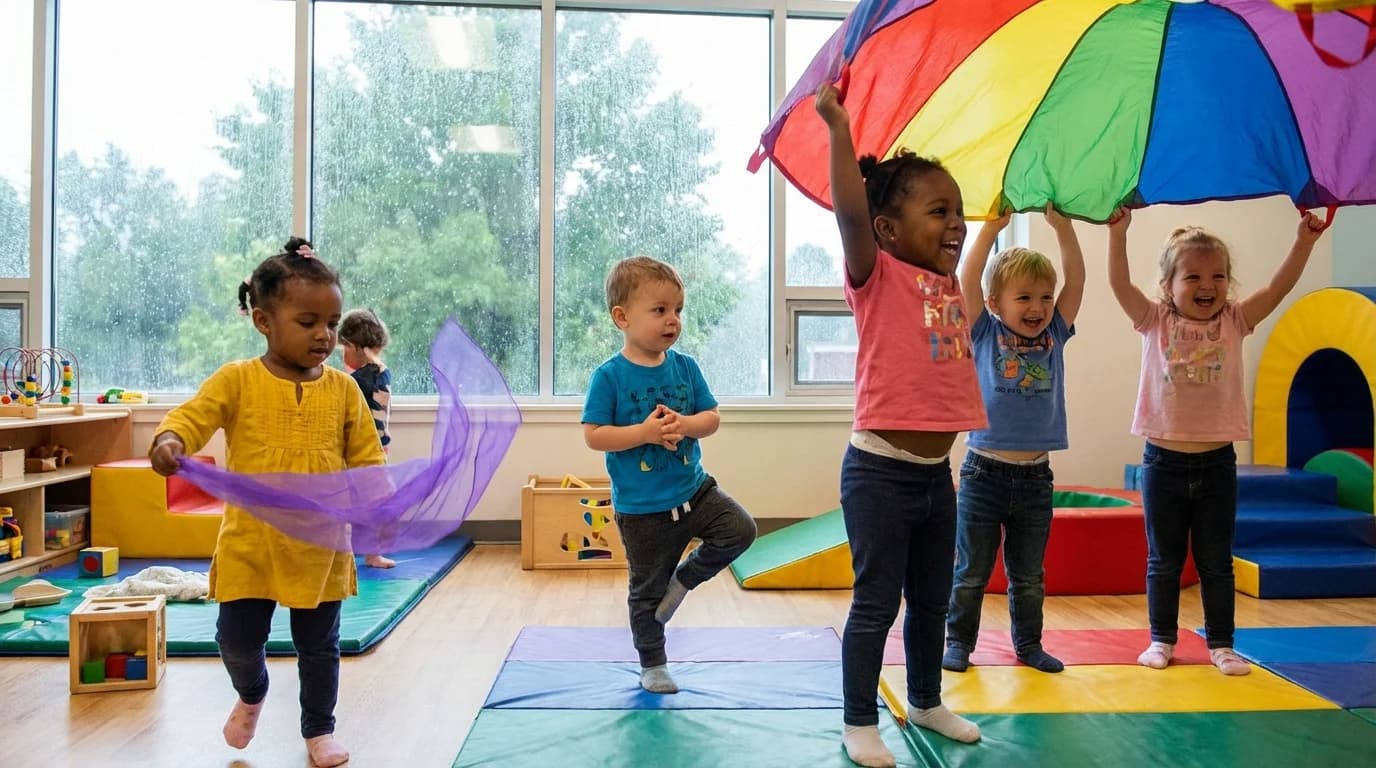
Brooklyn summers bring plenty of sunshine, but they also bring those sudden, heavy downpours that can last all morning or stretch into an entire day. For parents in Flatbush, East Flatbush, and across the 11226 zip code, a rainy forecast can trigger a familiar worry: will my child spend the whole day sitting around watching videos, or will their daycare find ways to keep them active, stimulated, and learning?
It is a legitimate concern. The Centers for Disease Control and Prevention (CDC) recommends that preschool-age children get at least three hours of physical activity in every 24-hour period. That recommendation does not come with a weather exception. At high-quality daycare programs, rainy days are not lost days. They are opportunities to get creative, introduce new experiences, and prove that learning and movement can happen in any conditions.
Why Indoor Gross Motor Activity Matters for Young Children
When we think about physical development in early childhood, we often picture outdoor play: running, climbing, riding tricycles, digging in sand. But gross motor skills, the large-muscle movements that involve the arms, legs, and torso, can be developed just as effectively indoors when teachers plan intentionally.
According to the American Academy of Pediatrics (AAP), physical activity in early childhood does far more than build strong muscles. It supports brain development, improves sleep quality, builds social skills through cooperative play, and lays the foundation for lifelong physical health. Children who are active during their daycare hours also tend to be better regulated emotionally, a benefit that every parent and teacher appreciates.
The key difference between a daycare that handles rainy days well and one that does not comes down to planning. At Einstein Daycare, our teachers do not wait for the rain to start before thinking about indoor activities. Rainy-day plans are part of our weekly curriculum design, built into our approach through the Teaching Strategies framework that guides everything we do. You can read more about how this curriculum shapes daily life in our post on what Creative Curriculum looks like at an East Flatbush daycare.
Indoor Obstacle Courses: The Gold Standard of Rainy-Day Movement
If there is one activity that reliably gets toddlers and preschoolers moving, laughing, and problem-solving on a rainy day, it is the indoor obstacle course. With nothing more than classroom furniture, tunnels, balance beams, stepping stones, and a bit of imagination, teachers can create a physical challenge that keeps children engaged for extended periods.
A well-designed indoor obstacle course targets multiple developmental areas simultaneously. Climbing over cushions and crawling through tunnels build gross motor strength and coordination. Following a sequence of stations exercises executive function skills like working memory and planning. Waiting for a turn and cheering on a classmate develop patience and empathy. And when teachers narrate the course using positional words like "over," "under," "through," and "around," children build spatial vocabulary naturally.
At Einstein Daycare, our teachers rotate obstacle course designs so that children encounter new challenges regularly, ensuring comprehensive physical development across the weeks.
Yoga and Movement: Calm Bodies, Focused Minds
Yoga is one of the most effective rainy-day activities for young children, and it is a cornerstone of our enrichment programming at Einstein Daycare. Unlike high-energy gross motor play, yoga offers children the chance to develop body awareness, flexibility, and self-regulation skills in a calm, focused environment.
Research published by the National Association for the Education of Young Children (NAEYC) supports the use of yoga and mindfulness practices in early childhood settings, noting benefits that include improved attention, reduced anxiety, and greater emotional resilience. For toddlers and preschoolers, yoga takes a playful form: children pretend to be trees swaying in the wind, dogs stretching in "downward dog," or butterflies opening their wings.
On rainy days, yoga sessions serve a dual purpose. They provide genuine physical activity, building strength and flexibility, while also helping children transition from the excitement of indoor play to quieter activities like storytime or rest. If you are curious about how movement and music programs support early development more broadly, our post on why movement and music matter at an East Flatbush preschool explores this topic in depth.
Dancing and Music: Getting Hearts Pumping
Sometimes the best rainy-day strategy is the simplest: turn on music and let children dance. Dancing is an outstanding cardiovascular activity for young children, and it requires no equipment, no setup, and no instructions. Put on an age-appropriate playlist, and toddlers will start moving instinctively.
But in a quality daycare setting, music and movement time goes beyond free-form dancing. Teachers introduce structured activities like freeze dance (which develops impulse control and listening skills), movement songs that help children follow multi-step directions, instrument play with maracas and rhythm sticks that builds fine motor control and early math skills, and parachute games that develop teamwork and upper body strength.
Sensory Activities: Messy, Meaningful, and Active
Rainy days are the perfect excuse to break out the sensory bins, water tables, and messy play stations that children love and teachers sometimes hesitate to set up on busy outdoor-play days. Sensory play is not just fun. It is a research-backed approach to early learning that supports cognitive, physical, and emotional development.
The Zero to Three organization, a leading authority on infant and toddler development, emphasizes that sensory experiences are fundamental to how young children learn about their world. When a child squishes playdough, pours water, scoops rice, or paints with their fingers, they are building neural pathways that support scientific thinking, mathematical concepts, and language development.
Effective rainy-day sensory activities include:
- Water play: Pouring, measuring, and experimenting with objects that sink or float teaches early science concepts and develops fine motor skills.
- Playdough and clay: Rolling, squeezing, cutting, and shaping build hand strength essential for later writing skills.
- Sensory bins: Containers filled with rice, dried pasta, sand, or shredded paper, along with scoops, cups, and small toys, provide open-ended exploration.
- Painting and art: Large-scale painting on easels or on paper spread across the floor gives children full-body creative expression.
For a deeper look at how sensory play supports early childhood development, see our post on sensory play benefits in early childhood in Flatbush.
Dramatic Play: Building Worlds Without Going Outside
Rainy days are when dramatic play centers truly shine. With extra indoor time, teachers can set up elaborate dramatic play scenarios that extend children's imaginations and build critical social-emotional skills. The NAEYC's research on play consistently demonstrates that pretend play is one of the most important activities in early childhood, supporting language development, empathy, problem-solving, and self-regulation.
On a rainy day, a creative classroom might transform into:
- A veterinary clinic: Children take turns being the veterinarian, the pet owner, and the receptionist, learning about animal care, empathy, and sequencing.
- A grocery store: Sorting play food, making lists, counting items, and using a play cash register build math, literacy, and social skills simultaneously.
- A weather station: The rain itself becomes a learning opportunity. Children can observe the weather from windows, create weather charts, and "report" the forecast to their classmates, building observational skills and vocabulary.
- A construction site: Building with blocks, cardboard boxes, and other materials develops spatial reasoning, engineering thinking, and cooperative problem-solving.
Indoor Science: Turning Rain into a Learning Opportunity
A rainy day provides a natural springboard for science exploration. Quality daycare programs use weather events as teachable moments, helping children make connections between the natural world and their classroom experiences.
Simple rainy-day science activities include collecting and measuring rainwater to introduce volume and weather observation, watching raindrops race down a window to build observational skills, testing which materials are waterproof to combine fine motor practice with scientific inquiry, and identifying cloud types to introduce early earth science in an accessible way.
The Head Start Early Childhood Learning and Knowledge Center (ECLKC) offers extensive resources on how early science education builds a foundation for later STEM learning, something that programs following the Creative Curriculum framework integrate into daily instruction.
Managing Energy Levels on Indoor Days
One of the biggest challenges on rainy days is managing children's energy levels throughout the day. Without outdoor recess to burn off steam, children can become restless, overstimulated, or frustrated. Experienced teachers know that the key is alternating between high-energy and calming activities in a predictable rhythm.
The key is alternating between high-energy and calming activities in a predictable rhythm: an obstacle course or dance party followed by sensory play, then yoga before lunch, dramatic play or science after rest, and music followed by quiet story time in the late afternoon. This "peaks and valleys" approach helps children self-regulate and prevents the buildup of restless energy that often leads to behavioral challenges. At Einstein Daycare, this thoughtful scheduling is part of every day, rain or shine. To see how a full day unfolds in a structured daycare setting, visit our post on a typical day at daycare in Brooklyn.
Brooklyn Indoor Destinations for Weekends and Holidays
While your child's daycare handles rainy weekdays, you might find yourself looking for indoor activities on rainy weekends. Brooklyn offers several outstanding indoor destinations for families with young children:
- Brooklyn Children's Museum: Located in Crown Heights, this is the world's first children's museum and features hands-on exhibits designed specifically for children ages birth through eight. Sensory-rich and educationally grounded, it is an ideal rainy-day destination.
- Brooklyn Public Library branches: Many branches offer free storytime sessions, craft activities, and early literacy programs for toddlers and preschoolers. The Flatbush branch on Linden Boulevard is particularly popular with families in the 11226 area.
- Indoor play spaces and community centers: Several Brooklyn neighborhoods have indoor play spaces with climbing structures and imaginative play areas, and many community centers in Flatbush and East Flatbush offer drop-in toddler gym sessions on rainy days.
What to Look for in Your Daycare's Rainy-Day Approach
When evaluating a daycare in Flatbush or anywhere in Brooklyn, ask about their rainy-day plans. A high-quality program will explain how they ensure children get physical activity on indoor days, whether they have dedicated gross motor equipment, how their curriculum adapts to weather changes, and what their screen-time policy is during indoor days. At Einstein Daycare, our answer to the screen-time question is simple: we do not use screens as a substitute for active engagement. Every rainy day is planned with the same intentionality as a sunny one, because your child's development does not take a day off just because the weather does.
Rain or shine, your child deserves a daycare that keeps them active, engaged, and learning every single day. At Einstein Daycare in Flatbush, our teachers plan intentional indoor activities that support physical, cognitive, and social-emotional development, even when the skies open up. Schedule a visit to see our classrooms in action by requesting a tour online or calling us directly at (718) 618-7330.